
Gardening
Plants aren't just decorations; they are hard workers that improve our environment. They clean the air, improve the soil's ability to clean water, moderate extreme air temperatures, and provide food and shelter for wildlife and pollinators.
Planting

Planting 101

Choosing the "Right" Plant
Plant taller trees away from utility lines

Plants all need the same things, but they don't all have the same needs. Some plants need more sun, some need more shade. Some plants need a lot of water, some need very little, and everything in between…
Putting the right plant in the right place, not only increases the likelihood of a happier healthy plant, but also reduces the likelihood of big problems later.
Evaluate what you have to work with. The physical aspects that are there, will direct how you can or should proceed.

Landscaping Tips
-
Use the shape of the land and the availability of light and water to shape your design.
-
When you're designing a landscape, keep planting zones in mind.
-
Group plants together that all have the same moisture and light requirements.
-
Make sure plants that require a lot of water are near a water source. (Sometimes that means a hose or rain catchment)
-
Make sure that plants that require more of your attention are easily accessible.
-
Consider the mature size of a plant. Make sure they have room to grow and make sure that plants that require more sun are not planted next to a plant that will grow and shade them out.


Native plants have adapted over thousands of years to each region’s unique environmental conditions.
-
Native plants are sustainable, adapted to thrive in their region’s soils and weather conditions.
-
Many natives are deep-rooted, slowing down stormwater and improving water quality and reducing erosion.
-
Natives don't need fertilizer or extra watering once established.
-
Native plants provide quality food and shelter for wildlife (habitat).
-
Native plants are beautiful.
-
Native plants (especially "Keystone" plants) are needed by many of our native pollinators and other wildlife who will not survive without them.
Including native plants in your yard will create a welcoming sanctuary along with many other benefits.


Why we need Native Plants

If you missed our yearly plant sale or we sold out of the plants you were hoping for, browse this map to find local retail and wholesale companies selling native plants.


Planting for pollinators
The Xerces Society has collaborated with the Lady Bird Johnson Wildflower Center to create plant lists that are attractive to native bees, bumble bees, honey bees, and other beneficial insects, as well as plant lists with value as nesting materials for native bees. These lists can be narrowed down with additional criteria such as state, soil moisture, bloom time, and sunlight requirements.
Xerces.org 2014 Maritime NW Planting.pdf
Pollinator.org 2013 Pacific Lowland planting.pdf
OSU 2020 Enhancing Urban Pollinator Landscapes.pdf
Xerces 2013 Hedgerows for Pollinators.pdf
Xerces 2015 Western OR & WA Cover for Pollinators.pdf
NW Meadowscapes Pollinator Meadow Planting Advice
WNPS Water-wise Plants for Pollinators.pdf
Washington Native Plant Society Plant Lists and Links

Manure Share
This is a voluntary, community resource, connecting farmers who have excess manure on their site with locals who need manure to improve soil in gardens and/or landscapes. Skagit Conservation District will maintain this list. It's simple, FREE, and is a great way to recycle valuable nutrients and organic matter!


For those seeking manure:
1. How much manure do you need?
Calculate volume needed (depth x area). Convert to cubic yards (27 cubic feet in one cubic yard). Plan for the number of truck loads required for target volume. Note: most pickups can only handle 3/4 - 1 yard at a time. If you are getting a lot of material, chose a farm with a loader or plan to spend a lot of time with your shovel loading your truck
2. When will you need the manure?
Some farms have manure piles that are not accessible during winter.
3. Are you looking for “Aged” or “Fresh” material?
Older material may be closer to “finished compost” than newer material. See the “Age” column in the Manure Share Source List. If you want old material, be sure to ask the farmer. Often the oldest material is at the back of pile, and the material at the front of the pile is from yesterday. Let the farmer know what you want; they may be able to load the older material for you. It is worth asking.
4. What is your end goal?
If mulch for landscaping; a manure pile with mostly bedding is a good choice. However, for composting for your garden, a material with little or no bedding is better choice (check the “manure/bedding” column in the Manure Share Source List). Know that some beddings will compost faster (straw breaks down quicker and cedar shavings take a very long time).
5. How do you control the weeds?
Weeds can be a real problem with some compost piles. Contrary to popular belief, horses don’t “poop” out significantly more weeds than cows. Weeds present in manure piles, are generated primarily from seeds of weed plants growing near the manure pile. Keep the pile covered with a tarp to prevent weed seed invasion and to compost the pile. The heat and time involved in composting will kill most weed seeds. Because we can’t vouch for the weed seed content of these manure piles, we highly encourage you to cover and compost this material for a month or two before applying it.


LID Landscaping (Rainscaping)
The amount of area covered by plants affects the amount of water that will infiltrate the soil.
Greater impervious areas (like roads, roofs, and parking lots) result in greater amounts of water runoff.
Plants Reduce Energy & Maintenance Costs
Shade from trees keeps homes and yards cooler in the summer.
In the winter, Trees and shrubs slow the wind and reduce wind chill.
Ground covering plants reduce the amount of water evaporating from the soil which therefore requires less water.
Soil effectively covered by plants, shades out weed seeds, so requires less maintenance than landscape with exposed soil.
Plants protect the soil from wind and water erosion and reduce the amount of pollutants that enter our waterways.
Turf grass vs other vegetation
While turf grass is better than pavement at allowing water to infiltrate the soil, research shows that areas covered with turf grass control much less water than other vegetation. Therefore, the amount of lawns and other grass areas at land development sites should be minimized. The use of plants, especially native ground cover, shrubs, and trees, can provide a low-maintenance alternative to turf grass, resulting in lower fertilizer and water needs.

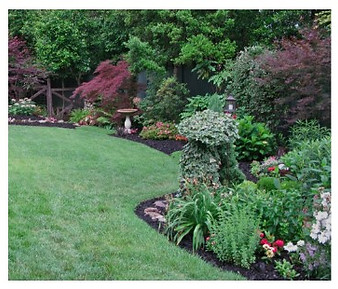
Lawn Reduction Tip:
Reducing the size of excessive lawns can be done gradually over several seasons.
An easy way to start is by expanding areas already established with shrubs and trees. Start by converting areas that are difficult to mow, such as corners, edges, and under trees.
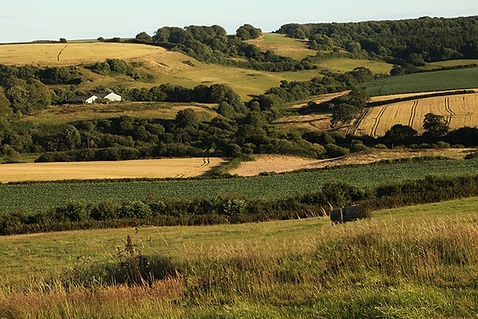
Hedgerow, Filter strip, or Vegetated buffer
A strip of plants at the edge of an area that slows surface water runoff, assists in infiltration, and prevents soil erosion.
-
Can be created by preserving existing vegetated areas over which runoff will flow or by planting new vegetation.
-
Should be located immediately downstream of roadways and parking lots for pollutant removal, groundwater recharge, and runoff volume reduction.
-
When located along streams, creeks, and other waterways can help mitigate thermal runoff impacts and provide wildlife habitat.


Rain Gardens
A rain garden is a landscaped depression in the land, with soil designed to help rainwater runoff from a roof, driveway or other impervious surfaces to soak into the ground and be filtered.

Bioretention Cells, Bioswales, and some Hedgerows are sometimes referred to as "Rain Gardens", because they are doing much the same thing in different situations. For example, a "Bioswale" is a kind of rain garden where water is slowed and filtered, but much of the water is directed to another location.
Bioretention is a more complex rain garden with drainage systems and amended soils.
Hedgerows are not technically rain gardens but can be used to slow surface water as it heads down slope, as an edge to a Bioswale, or as check dam.
A Bioretention cell (strip or trench) is more complex rain garden with engineered drainage systems constructed in a slightly recessed landscaped area with a specialized soil mixture, an aggregate base, an underdrain, and site-appropriate plants.

Bioretention
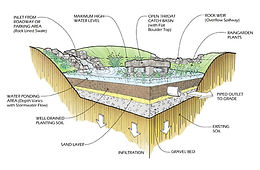

A bioswale is a slightly recessed landscaped area constructed downstream of a runoff source. At the beginning of a rain event, a bioswale absorbs and filters water runoff. Once the soil-plant mixture below the channel becomes saturated, the swale acts as a conveyance structure to a bioretention cell, wetland, or infiltration area.
There is a range of designs for these systems. Some swales are designed to filter pollutants and promote infiltration and others are designed with a geo-textile layer that stores the runoff for slow release into depressed open areas or an infiltration zone.
Bioswale


Curb cuts are a way to retrofit old stormwater systems. Openings are made in curbs to allow water to flow away from roads and parking lots and into raingardens or planted areas where the water can filter into the soil. This benefits the local groundwater systems and reduces the stormwater load downstream.
Curb Cut Extension

Curb Cut Raingarden

Curb Cut Inlet

Rain gardens are designed to be self-sufficient. Some weeding and watering will be needed in the first two years, and perhaps some thinning in later years as the plants mature, but a well-planned raingarden can be maintained with little effort after the plants are established. Rain gardens do not require fertilization.
Rain gardens' function depends on soil and local weather conditions. Take the time to plan effectively.
Note: Don’t locate a rain garden within 10 feet of a building foundation, near the edge of a steep slope or bluff, in low spots that do not drain well, where groundwater is within one foot of the bottom of the finished rain garden, over a septic drain field or tank, over shallow utilities (call before you dig), or in areas that would require disturbing healthy native soils and vegetation. If the garden is near the road, select plants that maintain visibility.
Rain Garden Design Tips
Make it part of the landscape. It should work together with and be visually and functionally integrated into the rest of the landscape.
Choose a shape. Consider all the rules of composition, screening, and circulation—not just the rule that says to put a rain garden in a low spot 10 feet from the house.
Integrate with other gardens. Consider making a depression within a perennial bed or shrub border (especially if space is tight and you don’t have room for a larger rain garden that stands alone).
Create repetition. If a large rain garden won't do, consider making several smaller raingardens.
Rain Garden Maintenance -New
-
New plantings require extra care during the first 1-3 years.
-
Make sure new plants receive a deep watering 1 or 2 times per week for the first several months and then at least once per week for the first year.
-
Apply a good layer of mulch to maintain soil moisture and reduce weeds.

Good maintenance while the garden is becoming established is important.


Rain Garden Maintenance -Yearly
Keep the Flow
Water flowing into the rain garden can carry with it various types of debris that can clog the soil mix and slow drainage.
-
At least twice a year, check around the inlet and overflow areas for debris build-up such as leaves, sticks, and other items.

Check the Inlet
-
Maintain a cover of decorative rock around the inlet and overflow area to protect the soil.
-
Look for areas where water may not be soaking into the ground. This may be due to fine sediment or compaction of the soil.
-
Remove sediment that may be building up and rake the soil surface. If you suspect compaction, break up and loosen the soil when it is not saturated.


Maintain soil coverage
-
Every year check the mulch layer and, if needed, apply enough to maintain a layer of shredded or chipped wood mulch that is about 3 inches deep all throughout your rain garden—on the bottom, the sides, and around the perimeter.
-
Replace any dead plants to fill in holes
Like mulch, full coverage of plants provides multiple benefits for rain gardens by helping to:
-
Keep the soil moist.
-
Replenish organic material in the soil.
-
Prevent erosion.
-
Discourage weeds
Maintenence Tips
-
Edging (such as pavers, stones, etc.) can facilitate access for maintenance and provide separation from lawn and other landscaped areas.
-
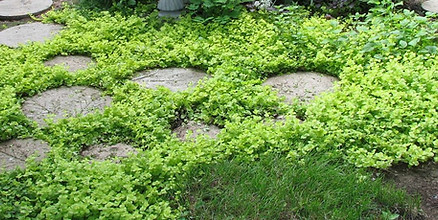
To maintain access to the middle of the garden for weeding and other tasks. A few strategically placed flat rocks or pavers can allow access without compacting the soil or leaving room for weeds.
-
Pull weeds early when the soil is moist and the weeds are small. Don't let them go to seed.
Native plants for Rain gardens
Plants in zone 1 need to be able to tolerate wet conditions and seasonal flooding.


Plants for shady zone 1
Slough sedge (Carex obnupta)
Small-fruited bulrush (Scirpus microcarpus)
May Lily (Maianthemum dilatatum)
Pacific waterleaf (Hydrophyllum tenuipes)
Ferns Lady fern (Athyrium filix-femina)
Deer fern (Blechnum spicant)
Goat's beard (Aruncus dioicus)
Red-twig dogwood (Cornus sericea)
Black twinberry (Lonicera involucrata)

Plants for sunny zone 1
Dagger-leaf rush (Juncus ensifolius), Taper-Tipped rush (Juncus acuminatus)
Cascade penstemon (Penstemon serrulatus)
Henderson’s checker-mallow (Sidalcea hendersonii)
Rocky Mountain Iris (Iris missouriensis)
Red-twig dogwood (Cornus sericea)
Pacific ninebark (Physocarpus capitatus)
Black twinberry (Lonicera involucrata)
Pacific crabapple (Malus fusca)
Plants in zone 2 need to be able to tolerate moist to occasionally flooding conditions.

Plants for shady zone 2
May Lily (Maianthemum dilatatum)
Oregon wood sorrel (Oxalis oregana)
Sword fern (Polystichum munitum)
Lady fern (Athyrium filix-femina)
Low Oregon Grape (Mahonia repens)
Snowberry (Symphoricarpos albus)
Salal (Gaultheria shallon)
Western Pussy Willow (Salix scouleriana)
Cascara (Frangula purshiana)
Plants for sunny zone 2
Daylily (Hemerocallis spp.)
Giant camas (Camassia leichtlinii)
Henderson's Checker Mallow (Sidalcea hendersonii)
Douglas Iris(Iris douglasiana)
Red-twig dogwood (Cornus sericea)
Snowberry (Symphoricarpos albus)
Western Pussy Willow (Salix scouleriana)
Tall Oregon grape (Mahonia aquifolium)
Pacific crabapple (Malus fusca)
Plants in zone 3 need to be able to tolerate moist to dry conditions.

Plants for shady zone 3
Inside-out flower (Vancouveria hexandra)
Western bleeding heart (Dicentra formosa)
Sword fern (Polystichum munitum)
Evergreen huckleberry (Vaccinium ovatum)
Low Oregon grape (Mahonia nervosa)
Rhododendron macrophyllum
Vine maple (Acer circinatum),
Cascara (Frangula purshiana)
Indian plum (Oemleria cerasiformis)
Plants for sunny zone 3
Black-eyed Susan (Rudbeckia hirta)
Cooley's Hedge-nettle (Stachys cooleyae)
Oceanspray (Holodiscus discolor),
Red-flowering currant (Ribes sanguineum)
Snowberry (Symphoricarpos albus)
Oregon Boxleaf (Paxistima myrsinites)
Tall Oregon grape (Mahonia aquifolium)
Serviceberry (Amelanchier alnifolia),
Oceanspray (Holodiscus discolor)
Mock Orange, Philadelphus lewisii